Cloudflare APO vs QUIC.cloud: Real-World Edge Cache & TTFB Tests

Edge caching and Time To First Byte (TTFB) critically enhance WordPress site performance and user experience. Cloudflare APO and QUIC.cloud stand as leading WordPress optimization solutions, offering similar CDN functionalities. This article conducts a real-world comparison of their edge caching and TTFB performance, helping readers choose the best service for their needs. Understanding how each service handles dynamic content and WordPress-specific challenges is important, especially for dynamic or WooCommerce sites. For instance, effective edge caching significantly reduces TTFB.
Site | Before TTFB | After TTFB | Percentage Reduction |
|---|---|---|---|
Listelist.com | 1.3s | 0.4s | 69% |
Permolitboya.com.tr | 1.7s | 0.4s | 76% |
This data highlights the impact of proper cache and edge optimization. This cloudflare apo vs quic.cloud comparison analyzes their wordpress performance as cdn providers. The quic.cloud vs cloudflare analysis examines cloudflare apo and quic.cloud for optimal edge cache delivery. For tailored optimization, consider a Get free website audit and 1vs1 consultation.
Key Takeaways
Cloudflare APO and QUIC.cloud both make WordPress sites faster. They store website copies closer to users. This helps websites load quickly.
Cloudflare APO works well for many types of WordPress sites. It helps dynamic content load fast. It is good for online stores or news sites.
QUIC.cloud works best with LiteSpeed servers. It is very good at making dynamic content load fast. This helps websites with many changes, like online shops.
You can use both Cloudflare and QUIC.cloud together. Cloudflare can handle general website speed and security. QUIC.cloud can handle specific dynamic content caching.
The best choice depends on your website's needs. Think about your server type and how much dynamic content you have. Both services make websites much faster.
Cloudflare APO vs QUIC.cloud: Core Overview
Cloudflare APO: Features and Benefits
Cloudflare APO, or Automatic Platform Optimization, significantly boosts WordPress site performance. This service uses Cloudflare Workers to cache dynamic content. It serves the entire WordPress site from its edge network. This ensures fast performance for global visitors and greatly improves Time to First Byte (TTFB). Cloudflare APO includes features like bypassing cache for logged-in users and specific cookies. This helps deliver correct content to different visitors. The Cloudflare plugin automatically purges cache for modified pages, including categories and tags. Cloudflare's testing shows TTFB improvements of 72% and FCP improvements of 23%. This leads to faster page load times and a better user experience. Cloudflare APO caches WordPress site HTML in Cloudflare's global edge servers using Workers KV. This acts as a distributed mirror for the origin server. Requests are served from the nearest data center, reducing the load on the origin server. This powerful optimization helps reduce the impact of geography on site speed.
QUIC.cloud: Features and Benefits
QUIC.cloud is a content delivery network (CDN) and website optimization service. It specifically designs for WordPress sites. It integrates seamlessly with LiteSpeed Web Server and the LiteSpeed Cache plugin. This service uniquely supports dynamic page caching. It serves dynamic WordPress pages from edge servers globally. It is the first CDN service capable of caching both static and dynamic content generated by WordPress. This is due to its native integration with LiteSpeed technologies. QUIC.cloud optimizes for WordPress sites. It offers unique features like dynamic content caching. It uses the QUIC protocol for faster and more reliable connections. It also provides robust protection against DDoS attacks. It integrates SSL certificates seamlessly. This enhances the overall security of WordPress sites. QUIC.cloud offers complete caching at the CDN level. It is the only CDN that caches both static and dynamic WordPress content. It uses LiteSpeed Cache’s Smart Purge technology for accurate content delivery. This quic.cloud vs cloudflare comparison highlights its strengths. QUIC.cloud improves website performance by enhancing the Time to First Byte (TTFB). This helps Google open websites faster. This contributes to better search engine rankings. This cloudflare apo vs quic.cloud overview shows both services' core strengths. The quic.cloud vs cloudflare debate often centers on these unique caching capabilities.
Caching and WordPress Integration
Edge Caching Strategies
Both Cloudflare APO and QUIC.cloud employ robust edge caching strategies to accelerate WordPress sites. Edge caching stores copies of website content closer to users. This reduces latency. Cloudflare APO uses its global network of edge servers to cache HTML and other assets. This ensures a high cache-hit ratio for repeat visitors. QUIC.cloud also utilizes its CDN for extensive caching. It was the first CDN to offer full-page HTML caching directly at the CDN level. This means the entire WordPress page can be served from the edge, significantly improving load times. Both services aim for maximum cache-hit rates to offload the origin server. Effective static caching is fundamental to their operations, ensuring a fast cache-hit for unchanging content. This edge delivery is crucial.
Dynamic Content Handling
Handling dynamic content is a key differentiator. Cloudflare APO uses Cloudflare Workers to cache dynamic WordPress content. This allows it to serve personalized or frequently updated pages from the edge. It intelligently decides what to cache and what to bypass. QUIC.cloud excels in dynamic content caching due to its deep integration with LiteSpeed. It can cache dynamic WordPress pages directly from its edge servers. This makes QUIC.cloud a true wordpress-first cdn for dynamic content. This advanced caching capability ensures even complex WordPress sites benefit from edge delivery. This improves the overall cache performance and increases the cache-hit rate for dynamic requests.
WordPress Plugin Setup
Setting up these services involves specific WordPress plugin configurations. For Cloudflare APO, users follow these steps:
Ensure your Cloudflare plan type is compatible.
Purchase APO if on a Free Plan.
Create the API Token from the Cloudflare dashboard.
Add your API Token to WordPress plugin settings and toggle Automatic Platform Optimization to "On."
For QUIC.cloud, the process integrates with the LiteSpeed Cache plugin:
Log in to your WordPress website and navigate to Dashboard > LiteSpeed Cache > General.
Once you have your domain key, click the “Link to QUIC.cloud” button.
Navigate to your Dashboard > LiteSpeed Cache > CDN settings page.
Toggle the CDN to ON. This completes the setup for QUIC.cloud's caching services.
TTFB Performance Benchmarks

Test Methodology
Measuring Time To First Byte (TTFB) accurately requires a robust methodology. Real-world tests for CDN services often involve a comprehensive approach to reflect global user conditions.
Multi-regional Approach: Tests were conducted over four weeks across more than 20 test nodes in North America, Europe, Asia, and Australia. This approach reflected realistic global user conditions.
Consistent Benchmarking: Each test was repeated at different times of the day. This mitigated anomalies caused by network congestion.
Real-User Simulation: Emulated requests were made by users with various devices and operating system configurations.
Comparative Analysis: Results were benchmarked against industry-standard CDNs to assess relative
performance.
Test environments were established in strategic regions like the United States, Europe, Asia, and Australia. These environments had similar network conditions for fair comparison. Standard industry tools such as Pingdom, GTmetrix, and custom scripts executed thousands of simultaneous requests. This simulated both low-latency and high-traffic scenarios. Data collection tools included Real User Monitoring (RUM) for actual user experiences and Synthetic Testing Platforms for simulating user behaviors under controlled conditions. Third-Party Measurement Services also provided cross-referencing and verification.
Advanced CDN testing techniques included geolocation testing. Tools like GeoPerf ensured traffic routing to the nearest node, minimizing latency. Load tests evaluated handling high traffic volumes and sudden spikes. These tests also assessed failover and disaster recovery mechanisms. Optimizing CDN configuration involved fine-tuning caching settings and implementing advanced features like origin shielding.
Global TTFB Results
Analyzing global TTFB results reveals how effectively each service delivers content from the edge. QUIC.cloud, with its specialized architecture, shows impressive performance in reducing ttfb.
Metric | QUIC Cloud CDN (HTTP/3) |
|---|---|
TTFB |
QUIC.cloud demonstrates excellent ttfb across various regions.
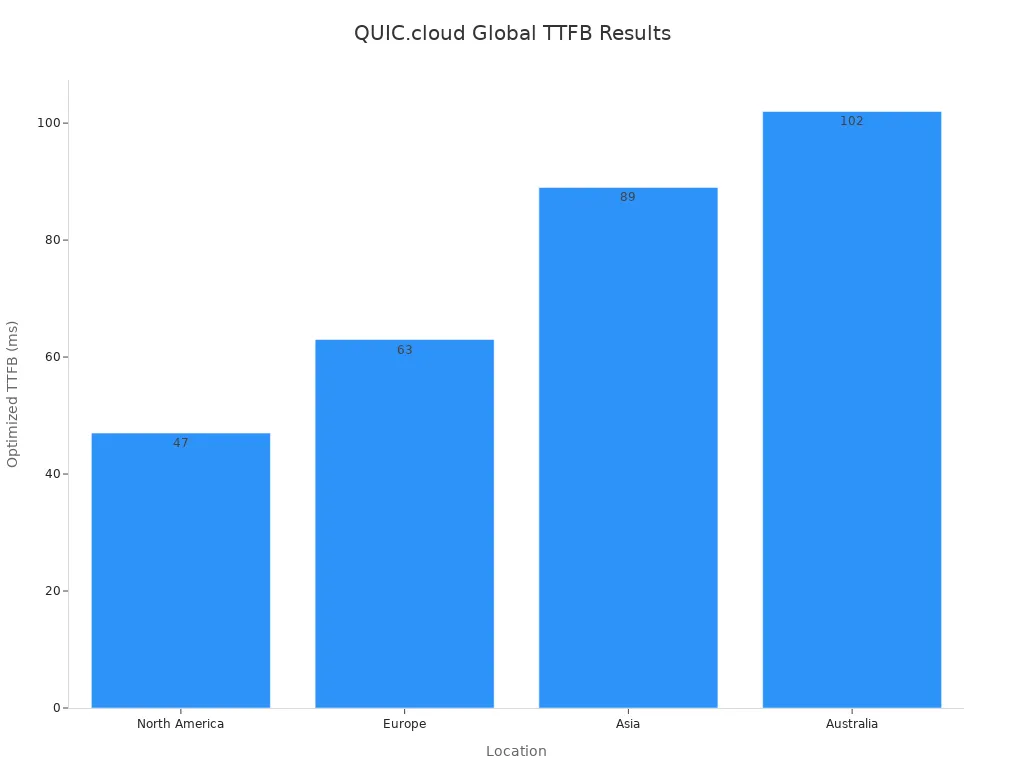
QUIC.cloud's average page fetching (ttfb) performance for USA, EU, and Oceania is reported to be less than 250ms. Cloudflare APO also significantly reduces ttfb. Cloudflare's own testing data shows a 72% ttfb reduction with Cloudflare APO. This highlights the consistent speed improvements both services offer across different test cities.
HTTP/3 and QUIC Impact
HTTP/3 represents the next major revision of the HTTP protocol. It significantly improves speed, security, and reliability. For a fast WordPress site, using a modern web server that supports HTTP/3 is highly recommended. The underlying transport protocol for HTTP/3 is QUIC. This protocol plays a crucial role in enhancing web performance.
A Cloudflare test demonstrated that ttfb was 12.4% faster when utilizing HTTP/3. This improvement comes from QUIC's ability to reduce connection setup latency and eliminate head-of-line blocking. QUIC allows multiple streams of data to be sent over a single connection independently. This means a lost packet in one stream does not block other streams. This makes QUIC particularly effective in environments with high packet loss or latency. Both Cloudflare and QUIC.cloud leverage QUIC to deliver faster content. QUIC.cloud, as its name suggests, is built around the QUIC protocol. This gives it a distinct advantage in optimizing for QUIC-enabled connections. The adoption of QUIC by these services ensures users experience quicker page loads and a more responsive browsing experience.
Network Reach and PoPs

The global network infrastructure of a CDN significantly impacts website performance. It directly affects how quickly content reaches users. This section compares the network reach of Cloudflare and QUIC.cloud, focusing on their Point of Presence (PoP) density and its effect on latency. A wider network means lower latency for users worldwide.
Cloudflare's Global Network
Cloudflare operates an extensive global network. This network ensures content delivery with minimal latency. Cloudflare's vast infrastructure includes numerous data centers strategically placed around the world. These Points of Presence (PoPs) bring content closer to the end-user. This reduces the physical distance data must travel, thereby lowering latency. Cloudflare's network helps deliver content from the edge efficiently. This global presence is a key factor in reducing latency for websites using Cloudflare. The sheer number of Cloudflare PoPs allows for excellent edge caching.
Provider | Approximate PoP Count |
|---|---|
Cloudflare |
This extensive network minimizes latency for users accessing content from any edge location. The large number of PoPs ensures that data travels a shorter distance, reducing latency. This robust edge network is crucial for fast content delivery and low latency. Cloudflare's commitment to expanding its network further reduces latency for global users. The network's design prioritizes low latency.
QUIC.cloud's Network
QUIC.cloud also maintains a growing global network. This network focuses on delivering content with low latency, leveraging the QUIC protocol. QUIC.cloud currently operates a growing network of 79 Points of Presence (PoPs) globally. This network is designed to optimize for the QUIC protocol, which inherently reduces latency. The QUIC protocol helps minimize connection setup latency. QUIC.cloud's network ensures that content reaches users from the nearest edge server. This reduces latency and improves overall page load times. The QUIC protocol is central to QUIC.cloud's strategy for reducing latency. Its network, though smaller than Cloudflare's, is highly optimized for the QUIC protocol. This optimization helps achieve low latency for users. The focus on QUIC technology allows for efficient edge delivery and reduced latency. QUIC.cloud's network provides a strong foundation for fast content delivery, emphasizing the benefits of the QUIC protocol to lower latency.
WordPress Optimization Features
HTML and Object Caching
Both services offer robust HTML and object caching for wordpress sites. Cloudflare APO caches static HTML directly on Cloudflare's edge servers globally. It uses Workers KV, a distributed key-value database, for rapid global distribution of cached HTML. When a page is requested, APO first checks the local Cloudflare cdn cache. If not found, it retrieves the HTML from Workers KV. If neither contains the page, Cloudflare makes a single request to the origin server, caches the new HTML, and then serves it. This system effectively makes Workers KV a mirrored representation of the origin server. Requests from anywhere in the world are served by the nearest Cloudflare data center without needing to access the origin server. APO also extends its caching capabilities to third-party objects like fonts. It uses Cloudflare Workers to cache these fonts and can convert page HTML to internal CSS. This allows these assets to be served directly from the Cloudflare cdn, reducing external requests and improving page load times.
Feature | With WordPress Plugin | Without WordPress Plugin |
|---|---|---|
HTML TTL | 30-day removal | 30-day removal |
Cache Clearing | 30 seconds after post update | 30 minutes after post update |
Logged-in Users | HTML | HTML |
Specific Cookies (e.g., WooCommerce) | HTML | HTML |
Origin Server Load | Reduced, requests served from | Origin server still needed for |
Global Distribution | Utilizes Workers KV for global HTML distribution | Less efficient global distribution, relies on pull model |
Third-Party Object | Caches third-party fonts using Cloudflare Worker | N/A (not explicitly mentioned, but Worker functionality is core to APO) |
HTML Conversion | Converts HTML to internal CSS for | N/A (not explicitly mentioned, but Worker functionality is core to APO) |
QUIC.cloud cdn is unique in its ability to cache both static and dynamic wordpress content. It leverages LiteSpeed Cache’s Smart Purge technology to ensure accurate content delivery and timely purging. The cdn is built on the LiteSpeed server stack. It stores both public and private cached content. Complex dynamic content is cached with ESI support. Wordpress sites benefit from low TTFB by being served at the network edge. It boasts less than 10ms average latency in North America and Europe. HTTP/3 is supported end-to-end, from client to backend server. QUIC.cloud, with LiteSpeed Cache, efficiently manages dynamic content. It offers Private Cache for user-specific content like shopping carts. ESI (Edge Side Includes) caches traditionally uncacheable or private content blocks, such as random number widgets or the wordpress Admin Bar. Cache tags enable intelligent purging of related content. Cache varies support multiple cached versions of a single page for scenarios like multi-language sites or different mobile/desktop themes. LiteSpeed Cache handles these advanced caching scenarios, and quic.cloud extends this capability to the cdn level. The quic protocol is central to this optimization.
Image and Font Optimization
Cloudflare APO for wordpress optimizes font delivery by caching third-party fonts. This process rehosts fonts and serves them from Cloudflare's cache. It reduces the need for requests to leave Cloudflare's network and minimizes costly round trips. This optimization improves the time it takes to display text to the user. It enhances performance metrics like First Contentful Paint (FCP) and Speed Index (SI), as fonts often block page rendering.
QUIC.cloud offers comprehensive image optimization. Its Image Optimization service reduces the size of JPG and PNG images without compromising quality. It condenses them for quicker transmission and can optionally save them in next-generation formats like WebP or AVIF. The process is automated. Images are added to an optimization queue as soon as they are uploaded to the media library. This optimization improves LCP and FCP scores.
Auto Request Cron: Automatically sends new images to
quic.cloudforoptimization.Auto Pull Cron: Automates the retrieval of optimized images from
quic.cloud.Optimize Original Images: Enables
optimizationof JPG and PNG files.Next-Gen Image Replacement: Allows the LiteSpeed plugin to create and serve WebP or AVIF images to compatible browsers.
The quic protocol enhances this optimization.
Cache Invalidation
Effective cache invalidation ensures users always see the most current content. The quic.cloud cdn cache is managed by the LiteSpeed Cache plugin for wordpress. When the LiteSpeed Cache plugin purges cache on the origin server, the cdn-level cache is automatically purged as well. This optimization ensures consistency. In situations where automatic purging might fail, users have the option to manually purge the cdn cache. This optimization is crucial for dynamic content. The quic protocol helps with efficient cache updates at the edge.
Security and DDoS Protection
Cloudflare's Security Suite
Cloudflare offers a robust security suite. This suite protects WordPress sites from various online threats. Cloudflare provides free protection against Distributed Denial of Service (DDoS) attacks. DDoS attacks are a common threat to websites. Cloudflare's Web Application Firewall (WAF) rulesets are available on all paid plans. These rulesets specifically mitigate vulnerabilities and threats targeting WordPress. The WAF acts as a shield for your website.
Cloudflare's free plan includes a Basic Firewall. This firewall allows five custom rules. Users can block specific IP addresses, user agents, request methods, HTTP referrers, and countries. Cloudflare also offers Automatic HTTPS Rewrites. This feature eliminates mixed content issues. It rewrites insecure URLs to secure counterparts. This enhances both security and performance. Other features include Browser Integrity Check, which inspects HTTP headers to block bots. Cache Deception Armor protects against web cache deception attacks. Email Obfuscation scrambles email addresses to reduce bot scraping. Server Side Excludes hide sensitive information from suspicious traffic. This comprehensive approach makes Cloudflare a strong security partner for any website.
QUIC.cloud's Security
QUIC.cloud also provides essential security features for WordPress sites. It focuses on protecting websites while enhancing performance. QUIC.cloud offers robust DDoS attack protection. This safeguards websites from malicious traffic floods. The service also guards against WordPress-specific vulnerabilities. This ensures a secure environment for your site.
QUIC.cloud integrates SSL certificates seamlessly. This enhances the overall security of WordPress sites. The underlying quic protocol also contributes to a more secure connection. This cdn service prioritizes both speed and safety for its users.
Pricing and Value
Cloudflare APO Pricing
Cloudflare APO offers a straightforward pricing structure. Cloudflare APO costs $5 monthly for users on the Cloudflare free plan. This makes advanced optimization accessible. Cloudflare includes APO in all paid Cloudflare plans. This means users with Pro, Business, or Enterprise plans automatically receive this feature. The fixed monthly cost provides predictability for budgeting. This pricing model suits WordPress sites seeking consistent performance enhancements without variable charges.
QUIC.cloud Credit System
QUIC.cloud operates on a credit system for many of its advanced services. QUIC.cloud services generally require quota. The platform provides a free monthly quota. Users can purchase additional quota using account-level credit. This credit can be refilled through the QUIC.cloud shop. The dashboard displays quota usage and credit balance. Quota specifically applies to WordPress Optimization Services. These include Image Optimization, Page Optimization (Critical CSS, Unique CSS, Viewport Images), and Low-Quality Image Placeholder Generation. Quota measures usage, typically requests or calculations, and counts per domain. Monthly free quota is automatically assigned based on a tier system. Higher tiers receive more quota. Credit is an account-level currency. It acquires additional quota for any service and domain. Unlike free quota, purchased credit rolls over monthly and never expires. Users can purchase one-off Pay-As-You-Go quota boosts or subscribe to additional monthly quota. Purchasing additional quota with credit bypasses daily usage limits that may apply to free quota.
Cost-Effectiveness
The cost-effectiveness of Cloudflare APO versus QUIC.cloud depends on a WordPress site's specific needs and usage patterns. Cloudflare APO offers a predictable, flat monthly fee or inclusion in higher-tier plans. This makes it a clear choice for sites needing consistent, broad-spectrum CDN optimization. QUIC.cloud's credit system provides flexibility. Sites with fluctuating optimization needs or those heavily utilizing specific services like image optimization might find the credit system more economical. They only pay for what they use beyond the free quota. For a site heavily reliant on advanced WordPress optimization features, QUIC.cloud's credit system can offer significant value.
Use Cases and Recommendations
This section provides specific scenarios where each service excels. It also includes strategies for combining Cloudflare (free DNS/edge caching with Super Page Cache) and QUIC.cloud (dynamic caching). The recommendations also highlight Cloudflare for dynamic or WooCommerce sites.
When Cloudflare APO is Best
Cloudflare APO offers significant advantages for various WordPress sites. It excels in scenarios requiring broad global reach and robust performance for dynamic content.
WordPress sites with dynamic content, such as e-commerce stores or forums, benefit from Cloudflare APO's ability to cache and optimize even frequently changing elements.
Blogs and news sites, which often have a high volume of traffic and static content, see significant performance improvements through APO's full-page caching.
Any WordPress site aiming for faster load times and improved user experience, regardless of its specific niche, can leverage Cloudflare APO to reduce server load and deliver content more efficiently.
Sites with a global audience particularly benefit from Cloudflare APO's distributed caching network, ensuring content is served quickly to users worldwide.
Cloudflare APO is an excellent choice for sites prioritizing ease of setup and comprehensive global CDN coverage. It provides a powerful optimization layer without requiring a LiteSpeed server. This makes it ideal for users on shared hosting or those who prefer a simpler caching solution. For dynamic or WooCommerce sites, Cloudflare APO offers a strong foundation for performance.
When QUIC.cloud is Best
QUIC.cloud shines for WordPress sites that demand the highest level of dynamic content caching and advanced optimization features. Its deep integration with LiteSpeed Web Server and the LiteSpeed Cache plugin provides unparalleled control over caching.
QUIC.cloud is the best option for:
LiteSpeed Server Users: Sites running on LiteSpeed Web Server gain the most from QUIC.cloud. The native integration allows for superior dynamic content caching and precise cache control.
Highly Dynamic WordPress Sites: E-commerce platforms, membership sites, or forums with frequent content changes benefit from QUIC.cloud's ability to cache dynamic pages at the edge. This ensures personalized content loads quickly for each user.
Users Seeking Advanced Image and Page Optimization: QUIC.cloud's services, such as image optimization (WebP/AVIF conversion) and critical CSS generation, offer granular control over page assets. This leads to higher PageSpeed Insights scores.
Sites Prioritizing HTTP/3 and QUIC Protocol: As its name suggests, QUIC.cloud is built around the QUIC protocol. This provides a distinct advantage in leveraging the latest web technologies for faster and more reliable connections.
Budget-Conscious Users with Variable Needs: The credit system allows users to pay only for the optimization services they consume beyond the free quota. This offers flexibility for sites with fluctuating traffic or specific optimization requirements.
For WordPress users seeking maximum optimization and willing to integrate with the LiteSpeed ecosystem, QUIC.cloud offers a powerful and highly effective solution.
Hybrid Optimization Strategies
Many sites effectively combine Cloudflare and QUIC.cloud by using Cloudflare for its global CDN capabilities, security features like DDoS protection, and static asset delivery (images, CSS, JS). Concurrently, LiteSpeed Cache, integrated with QUIC.cloud, is leveraged for dynamic HTML caching and precise cache purging control. This setup minimizes latency for dynamic content while ensuring static files are served efficiently from a global network.
A hybrid approach can leverage the strengths of both services. This strategy involves using Cloudflare for its free DNS and edge caching of static assets, while QUIC.cloud handles dynamic caching.
Role | HTML Caching | Static Assets & Security |
|---|---|---|
LiteSpeed/QUIC.cloud | Primary responsibility for dynamic HTML and cache purging | Optional for other assets |
Cloudflare APO | Can handle edge caching, but requires careful configuration to avoid conflicts | Primary responsibility for static files, CDN, and WAF |
Recommended Split | LiteSpeed/QUIC.cloud manages HTML | Cloudflare handles static assets and security features |
When implementing a hybrid strategy, it is crucial to avoid double page caching, which can lead to conflicts and performance issues. Before deploying any paid plans, thoroughly test real-user metrics such as cache hit ratio, Time to First Byte (TTFB), and update propagation to ensure optimal performance and stability. This combined optimization approach can provide a robust solution for complex WordPress sites. The cloudflare apo vs quic.cloud decision often leads to this powerful hybrid model. This quic.cloud vs cloudflare combination offers comprehensive optimization.
Real-world tests highlight the strengths of both Cloudflare APO and QUIC.cloud for WordPress site performance, especially regarding edge cache and TTFB optimization. Cloudflare offers robust CDN and edge cache optimization, ideal for dynamic WordPress sites and WooCommerce. Its edge cache provides excellent performance. QUIC.cloud provides superior dynamic cache handling and advanced optimization, especially for LiteSpeed users. This optimization ensures efficient edge cache delivery. The best solution depends on specific site needs, budget, and technical expertise. Consider a hybrid approach for maximum optimization. Both services deliver substantial gains, enhancing user experience from the edge. This optimization is crucial for any WordPress site, improving edge delivery and overall cache efficiency. The right cache strategy is key for optimal performance.
FAQ
What is the main difference between Cloudflare APO and QUIC.cloud for WordPress?
Cloudflare APO caches dynamic WordPress content using its global network. QUIC.cloud, integrated with LiteSpeed, specializes in caching both static and dynamic WordPress content at the CDN level. It uses the QUIC protocol for enhanced performance.
Which service offers better TTFB performance?
Both services significantly reduce TTFB. Cloudflare's tests show a 72% TTFB reduction with APO. QUIC.cloud reports average page fetching TTFB of 80-120 ms, often less than 250ms globally. Performance varies based on specific site configurations and user locations.
Can I use Cloudflare APO and QUIC.cloud together?
Yes, a hybrid strategy is possible. Users can leverage Cloudflare for its global CDN, security, and static asset delivery. Concurrently, they can use QUIC.cloud (with LiteSpeed Cache) for dynamic HTML caching and precise cache purging. This avoids double page caching.
Is QUIC.cloud only for LiteSpeed server users?
QUIC.cloud offers the most benefits to users running LiteSpeed Web Server due to native integration. However, its CDN services and optimization features can still enhance WordPress sites on other servers, though with potentially less granular control over dynamic caching.
How do these services handle dynamic content like WooCommerce carts?
Cloudflare APO intelligently bypasses caching for logged-in users and specific cookies, like those for WooCommerce. QUIC.cloud, with LiteSpeed Cache, offers advanced dynamic content caching, including Private Cache for user-specific content and ESI for uncacheable blocks.